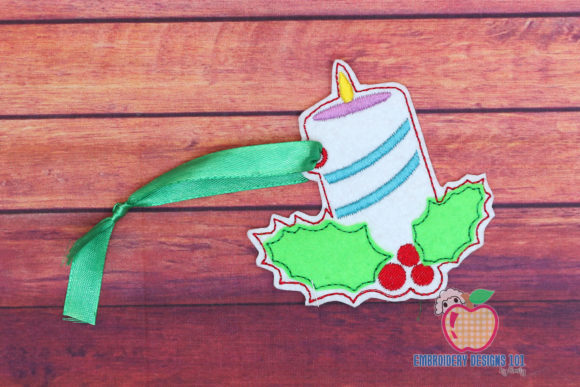
Decorative Candle Ornament
First Impression: Festive, Handmade, and Booth-Ready
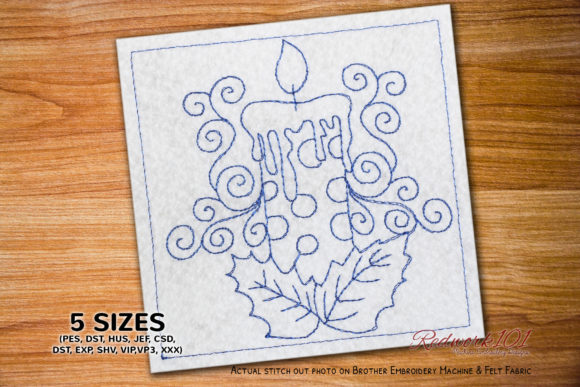
As an embroidery designer who’s prepped over 200 craft fair booths—from snowy holiday markets to sun-drenched summer artisan fairs—I opened the Decorative Candle Ornament file with one question: *Does this stop someone mid-aisle?* The answer is yes—when used right. It reads as festive without being kitschy, decorative without sacrificing clarity, and handmade without looking amateurish. There’s warmth in its shape and intention, not just ornamentation for ornamentation’s sake. It leans gently into Christmas charm but avoids overt religious or commercial clichés—making it versatile for boutique makers, Etsy sellers, and small shop owners who value subtle seasonal appeal.
Where It Shines on Craft Fair Products
This isn’t a design that dominates a tote bag front-and-center—it’s a quiet showstopper when placed intentionally. On embroidered tea towels, it lands beautifully in the lower corner or centered just above the hem, adding a thoughtful, giftable finish. As an apron embroidery, it works best on the pocket or upper left chest—not too large, not too small—giving a cohesive, curated look that signals care in both stitching and curation.
For embroidered patches, the Decorative Candle Ornament holds up remarkably well at 2.5–3 inches wide. Its clean outlines and balanced negative space prevent visual clutter, even after laundering. On fabric pouches and small market bags, it serves as a premium accent—especially when stitched in metallic or tonal thread colors against natural linen or oatmeal canvas. Pillow covers benefit most when the design is isolated on one corner or repeated subtly along a border—never stretched or scaled beyond its 4x4 hoop integrity.
It’s less effective on curved surfaces like caps (unless resized and re-digitized) or dense, textured terry cloth—where stitch density can flatten detail or cause puckering. And while it photographs well for Etsy listings and printable mockups, avoid placing it on dark fabrics without testing thread contrast first; fine candle wick lines or delicate flame highlights may vanish without high-visibility thread.
Production Realities: Speed, Clarity, and Consistency
The fact that Decorative Candle Ornament fits cleanly in a 4x4 hoop is a major win for batch production. You can run 8–12 pieces per hooping on lightweight cotton or quilting-weight linen—ideal for craft fair inventory builds. The included step-by-step PDF tutorial simplifies assembly for in-the-hoop ornaments, meaning fewer missed steps, fewer misaligned layers, and more consistent finished products.
That said, don’t skip the test run. Check for dense stitch areas—especially around the candle base or flame tip—where thread buildup could stiffen the fabric or snag during trimming. Tiny details (like subtle wax drips or fine wick texture) may blur on thick fabrics or low-thread-count cottons. Always stabilize with medium-weight cutaway or tear-away depending on your fabric texture—and never skip a stabilizer check on tea towels or textured weaves.
Visual Impact & Booth Strategy
In person, Decorative Candle Ornament performs strongest when grouped with complementary handmade products: a set of three embroidered tea towels (one with the candle, two with coordinating snowflake or evergreen motifs), a matching linen pouch holding cinnamon sticks and matches, or a mini embroidered market bag styled with a real taper candle inside. This creates narrative—customers don’t just see an ornament; they see a *moment*, a gift, a memory.
It elevates perceived value instantly. A plain muslin pouch becomes a $24 holiday keepsake when stitched with this design. A simple cotton apron transforms from functional to collectible. For Etsy sellers, pairing the Decorative Candle Ornament with strong printable mockups (showing it on multiple product types) increases conversion—especially when listed alongside keywords like “handmade Christmas gift,” “machine embroidery design,” and “small shop product.”
Careful-Use Notes Every Designer Should Know
- Dense stitch areas: Confirm spacing in flame and wick zones—overlapping stitches may cause stiffness or thread breakage on high-speed machines.
- Tiny details: Avoid scaling below 2 inches wide; fine elements lose definition on textured towels or dark fabrics.
- Curved surfaces: Not recommended for caps or mugs without redesign—hoop alignment and fabric stretch distort proportions.
- Fabric texture matters: Works best on smooth, stable weaves—test on your exact tea towel or pouch fabric before full production.
- Thread colors: Metallic gold, deep burgundy, forest green, or cream-on-cream deliver maximum elegance. Avoid low-contrast combos unless aiming for minimalist subtlety.
Designer-to-Designer Checklist Before Selling
- Test the Decorative Candle Ornament embroidery file on scrap fabric matching your final product—same weight, same weave, same dye lot.
- Check thread contrast under both natural and booth lighting—what reads well online may disappear under craft fair tent lights.
- Review spacing between design elements—tight loops or narrow gaps may collapse on heavier stabilizers.
- Confirm hoop size compatibility—yes, it’s labeled 4x4, but verify your machine’s actual usable area and margin clearance.
- Inspect stitch density visually and by touch—no hidden clusters that’ll compromise drape or durability.
- Use the correct stabilizer for your fabric type—cutaway for stretchy knits, tear-away for stable wovens, fusible for layered in-the-hoop builds.
- Create at least one real mockup—not digital, not printed—stitched, trimmed, and displayed as it would appear on your booth table.
- Compare how the design reads across 3–4 fabric colors—light, medium, and dark—to ensure versatility in your product line.
- Verify commercial licensing terms—this is a digital embroidery file intended for resale of finished products, but always confirm scope before listing on Etsy or wholesale platforms.
Final Thought: A Quiet Anchor in Your Holiday Line
The Decorative Candle Ornament won’t shout—but it doesn’t need to. In a sea of glitter, garlands, and oversaturated red-and-green, it offers warmth, craftsmanship, and quiet intention. It’s the kind of embroidery design that makes customers pause, tilt their head, and say, *“I want that for my kitchen. For my friend who loves candles. For my own little ritual.”* That’s not just decoration—that’s connection. And for craft fair sellers, handmade shop owners, and creative entrepreneurs building meaningful brands, that’s where real sales begin.