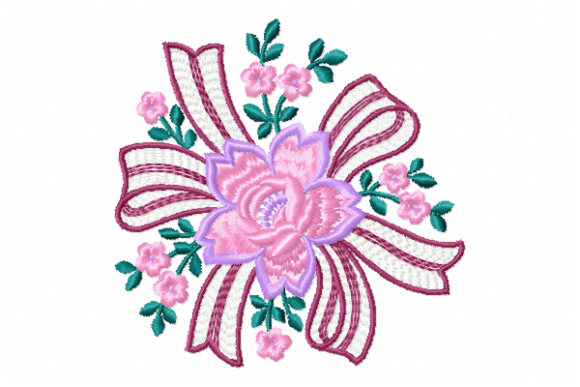
Floral Ribbon: A Thoughtful Embroidery Design for Small Business Branding
First Impression: Elegant, Approachable, and Versatile
As an embroidery designer who’s developed hundreds of commercial designs for small businesses—from neighborhood bakeries to indie florists—I immediately recognize Floral Ribbon as a quietly confident choice. The name alone evokes softness, movement, and organic charm—no sharp edges or aggressive geometry. It doesn’t scream “trendy” but rather whispers “trusted,” “handmade,” and “thoughtfully made.” That’s gold for small business merch. In the Floral Garden category, Floral Ribbon stands apart by balancing decorative detail with wearable restraint—ideal for brands that want warmth without whimsy, elegance without formality.
Real-World Performance Across Business Touchpoints
Floral Ribbon shines where small businesses need consistency and character: on embroidered patches, staff aprons, cap fronts, tote bags, and product packaging accents. I recently tested it for a local botanical boutique launching reusable linen totes—it anchored the design beautifully at the lower corner, adding visual weight without overwhelming the fabric’s natural texture. As a chest logo on custom apparel, its ribbon-like flow works exceptionally well on curved surfaces like polo shirts and work jackets, where rigid motifs often distort.
For café teams or craft studios, Floral Ribbon translates elegantly into sleeve embroidery on uniforms—its gentle curves follow arm contours naturally, avoiding puckering common with dense, angular designs. On caps, it holds up best when placed front-and-center on structured cotton twill (not low-profile mesh), especially when sized between 2.5"–3.5". As a branded patch, it reads clearly even at 1.75", provided stitch density is optimized—not over-packed, not under-defined.
Etsy sellers and handmade brands will appreciate how Floral Ribbon supports authenticity. When stitched in muted thread colors (sage, oat, dusty rose) on natural fabrics like canvas or unbleached cotton, it reinforces a premium handmade product feel—no digital sterility, just quiet craftsmanship. It also scales gracefully into printable mockups for client presentations, giving buyers immediate confidence in how their final product will look.
Where to Use Floral Ribbon With Intention
While versatile, Floral Ribbon isn’t universally foolproof—and that’s where experience matters. Avoid placing it on highly textured fabrics (like heavy terry cloth towels or bouclé knits) without thorough stabilizer testing; delicate ribbon elements can sink or blur. On dark uniforms, ensure high-contrast thread colors—especially along fine outlines—to maintain legibility after repeated laundering.
Small patch sizes (<1.5") demand special attention: some floral details may collapse visually or require simplification. Always test Floral Ribbon at your target size *before* digitizing for production. Likewise, curved surfaces—cap fronts, rounded tote handles, or apron pockets—benefit from slight manual adjustments to spacing and tension mapping. Don’t assume the default file handles all contours equally.
Stitch density is another silent factor. If the original Floral Ribbon embroidery file leans dense (common in ornate garden motifs), consider lightening fill areas for apparel use—especially on lightweight fabrics or items meant for daily wear. Overly dense stitching stiffens fabric, compromises comfort, and increases wear-related thread breakage.
How Floral Ribbon Strengthens Brand Identity
For small businesses, every embroidered element is a silent ambassador. Floral Ribbon builds brand identity through cohesion—not flashiness. Its consistent rhythm and organic line work create visual continuity across diverse touchpoints: a patch on a staff apron mirrors the same motif on a customer’s tote bag, which echoes the design on product tags or gift wrap. That repetition breeds recognition, trust, and perceived professionalism—even before a customer reads your logo.
Unlike generic clipart-style florals, Floral Ribbon feels intentional and ownable. When paired with thoughtful thread colors and quality fabric choices, it elevates perceived product value. Customers don’t just buy a towel—they buy a curated experience. That subtle lift matters most for Etsy sellers, craft fairs, and local boutiques competing on feeling, not just function.
Practical Designer Notes Before You Stitch
- Test in black and white first: Print a grayscale version to assess contrast and balance—details that vanish in monochrome won’t survive embroidery.
- Verify small-patch viability: Resize Floral Ribbon to your smallest intended application and check if stems, loops, and negative space remain legible.
- Review thread color contrast: Especially on dark or busy fabrics—what reads softly on screen may disappear entirely in stitch.
- Inspect spacing and underlay: Tight loops or overlapping petals need proper underlay to prevent gapping or distortion on stretchy or unstable fabrics.
- Confirm hoop size compatibility: Ensure your frame accommodates the design’s width and height without re-hooping mid-stitch—a frequent cause of misalignment in commercial embroidery.
- Test on real fabric + stabilizer: Run a sample on the exact material you’ll use, with your chosen cut-away or tear-away stabilizer. Fabric texture changes everything.
- Create a client-approved mockup: Present Floral Ribbon in context—not just isolated, but on a photo of the actual tote, cap, or apron.
- Compare alongside other design assets: Does Floral Ribbon harmonize with your logo, typography, and existing patterns? Consistency strengthens brand recall.
- Confirm commercial licensing: Since this is a digital embroidery file, verify usage rights cover small business merch, embroidered patches, and resale—especially for Etsy or wholesale distribution.
Ultimately, Floral Ribbon isn’t just another machine embroidery design—it’s a strategic tool. When applied intentionally, it bridges aesthetic appeal and functional durability, helping small businesses communicate care, craftsmanship, and clarity—one stitch at a time.